
Paramount Resident Lookup Coverage
A Paramount resident lookup is most reliable when each record is treated as a narrow answer. The Los Angeles County Assessor can anchor a known parcel, but its public portal is keyed to an address or 10-digit AIN and does not provide an online owner-name directory. A deed ties a person to a transaction, not proof of occupancy. Court, vital, voter, business, and license records each add a different kind of confirmation.
| Record | What It Confirms | Where | Access |
|---|---|---|---|
| Assessor parcel | Address, AIN, legal description, property facts, and event clues | Los Angeles County Assessor Portal | Free web search; owner and mailing fields are handled offline |
| Recorder deed | Grantor, grantee, recording date, document number, and legal description | LA County RR/CC real-estate records | Manual name/year index, appointment, mail, or ordered copy |
| Court case | Party name variants, role, filing timeline, status, and public docket events | Los Angeles Superior Court | $4.75 name search; documents and sealed material have limits |
| Voter record | One voter’s status, registered address, districts, and election information | Los Angeles County Registration Status | Authenticated self-check or controlled county request |
| Vital record | Birth, death, marriage, dissolution verification, or kinship evidence | LA RR/CC or CDPH-VR | Informational copies can be public; authorized copies are restricted |
| Business or license | Entity, agent, trade name, license status, or public professional contact | California SOS, RR/CC, or DCA | Free index searches; affiliation is not residence proof |
Start with the narrowest known fact. An exact case number beats a common surname, an address beats a guessed neighborhood, and a full birth name helps with a vital request. If the question is who else is along the same road, move to the Paramount Street Directory workflow instead of treating one person’s record as a whole street list.
When a specific municipal permit, application, or correspondence file is not posted, use Paramount’s Public Records Request Center with a focused description. It cannot bypass the separate custodian for deeds, vital records, courts, or restricted elections data.
Los Angeles Court Name Search
Paramount has no separate municipal court. Civil, small claims, family, probate, and criminal defendant searches use separate Los Angeles Superior Court access services. The public portal accepts a party or business name, or an exact case number, and the available service can ask for a filing date range, case type, or location. A name search costs $4.75, results are generally available within 24 hours, and purchased document images remain available for 30 days under the researched service terms.
| Field | Type | Required | Use in a resident lookup |
|---|---|---|---|
| Case Number | Text | Alternative | Best exact route; format depends on case type and courthouse |
| Last Name / Business Name | Text | Name mode | Tests a party or business spelling |
| First Name | Text | Optional or conditional | Narrows a common result |
| Filing Date Range | Date pair | Optional | Separates people with the same name |
| Case Type / Location | Dropdown | Optional | Separates civil, family, probate, criminal, and courthouse systems |
| Search / Clear | Buttons | None | Runs or resets the form; CAPTCHA, login, or payment may intervene |
A federal question belongs in PACER, which searches by party, court, case number, and filing date for federal dockets and documents. Account access is required; the researched fee model lists $0.10 per page, a $3 document cap in general, and a quarterly waiver when charges do not exceed $30.
The federal route is shown in the official PACER court records service.
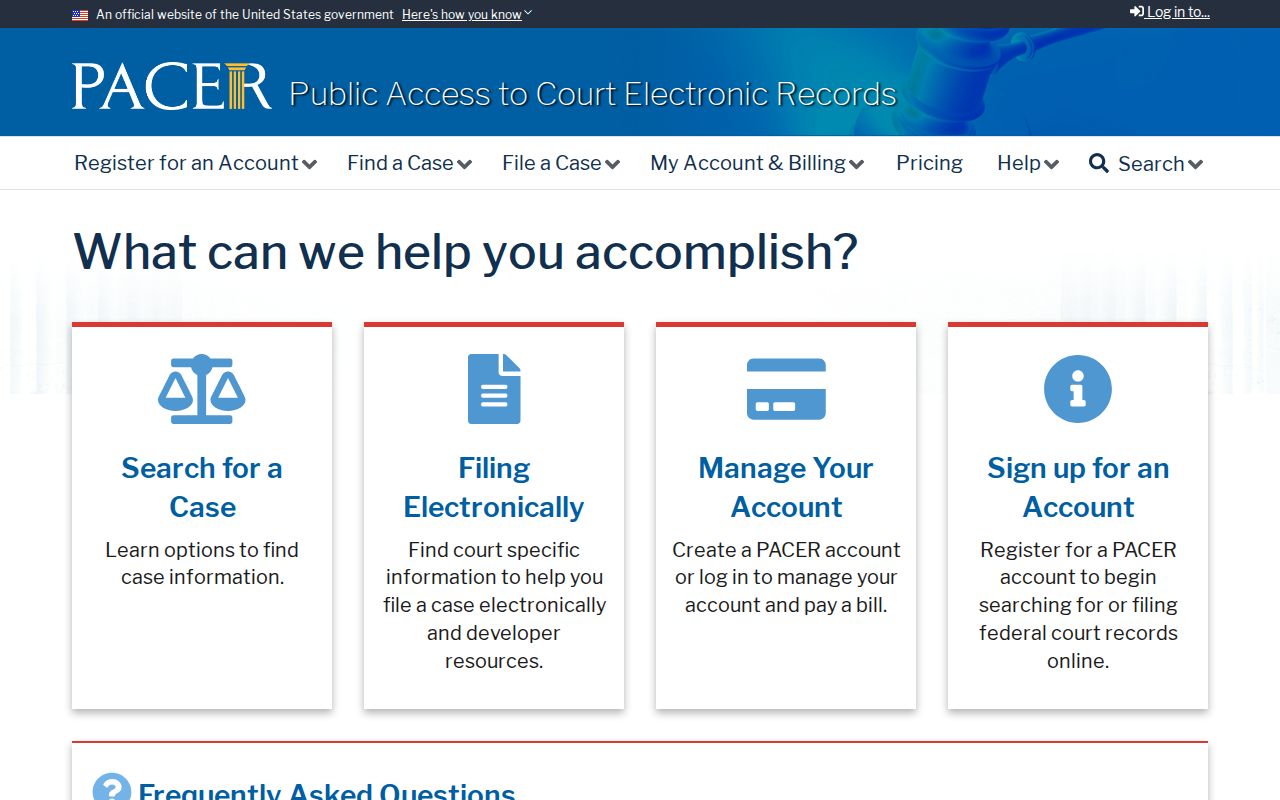
The image underscores the difference between a federal docket search and a Los Angeles County trial-court search, even when the same name appears in both.
For an older or unavailable file, courthouse public terminals and the Los Angeles Superior Court archives route are the fallback. Save the case number, document title, and date before asking the clerk; archived material may require retrieval time, and plain and certified copies are separate requests.
Matching a Paramount Name to Evidence
Same-name collisions are the central risk in a resident lookup. Keep the person’s full name, middle initial, spelling variants, compound surname, suffix, former surname, and any business or spouse name in a working note. A Paramount result is stronger when the courthouse, party role, filing date, associated property, business, or license number matches a second source. Two entries that share only a first and last name do not establish one person.
| Case number | Unique court identifier for the file and its later documents |
|---|---|
| Caption | Case title showing the named parties or matter |
| Filing date and type | When the matter began and whether it is civil, family, probate, or criminal |
| Parties and roles | Petitioner, respondent, plaintiff, defendant, decedent, conservatee, or another role |
| Attorneys | Counsel connected to a public case, when listed |
| Status and register of actions | Case state plus dated entries that describe court activity |
| Hearings and disposition | Public hearing dates, department, judgment, or other closing action |
| Document links | Electronic filings available under the court’s access rules |
Addresses, full birth dates, Social Security numbers, victim details, confidential family material, sealed filings, and sealed exhibits may be absent. An online blank result can reflect narrow electronic coverage, a sealed or relieved record, or a search spelling problem. Clerks can explain how to obtain a file, but they do not authenticate that a party with a common name is the person being sought.
Personal-use questions have distinct routes. A former classmate trail can begin with a yearbook, directory, library collection, or newspaper, then move to a current official record for confirmation. A birth-parent search must follow California’s statutory adoption-information and court process rather than open birth searching. The California Controller’s unclaimed-property search accepts an owner name and reported locality; its last reported address is a historical lead, and claim initiation is free. None of these paths proves a current address by itself.
Note: A docket role, middle initial, and filing date together are stronger identity clues than a shared name or city.
Probate Trails for Paramount Heirs
Probate is a lawful human-use path when a family is trying to locate an heir or understand an estate. The Los Angeles Superior Court probate search can return a decedent, conservatee, or party name, case status, petitions, and hearing information. Medical or investigative material may be sealed or redacted. A probate hit is a lead to a court file, not a complete family tree and not permission to contact every person named in it.
A careful heir trail pairs the probate case with a death certificate or a well-sourced obituary, then checks the recorded property trail when an estate held land. The deed and legal description can show a transfer, while the probate petition may identify an estate representative. Keep those roles separate. A person listed as an attorney, creditor, witness, or representative is not automatically an heir or current occupant.
- Record the exact probate case number, decedent name, filing date, and party role.
- Request the public petition or register entry that answers the narrow estate question.
- Compare the result with a vital record or recorded transaction before treating a relationship as confirmed.
Vital Copy Rules for Paramount Searches
California uses an authorized-versus-informational model rather than a blanket closure period. For a Paramount event, Los Angeles County RR/CC is the local custodian for county records, while the California Department of Public Health-Vital Records offers statewide products. Informational copies of public births, deaths, and nonconfidential marriages can generally be requested by anyone, but they carry an identity-use legend. Authorized copies require a qualifying relationship, identity details, and a sworn statement. Mailed authorized requests require notarization.
At the research date, CDPH lists 2026 fees of $31 for a birth record, $26 for a death record, $19 for a marriage record, and $18 for a dissolution record. County fees and vendor charges can differ, so confirm the live form before paying. A confidential marriage certificate is limited to a spouse or court order under Family Code sections 509 through 511. Adoption records and original birth certificates are sealed unless a statutory or court process allows access. A divorce decree comes from Superior Court; CDPH can provide only a supported verification product, not the full decree.
Online order pages, mail forms, and in-person counters are all part of the access chain. Forms ask for the registrant’s full birth name, event date and place, parents or spouses where relevant, the requester’s relationship, the copy type, signature, and payment. Historical indexes, church registers, cemetery records, newspapers, and probate can help locate an event, but a finding aid is not certified proof.
Note: California’s vital-record distinction is access by copy type, not a simple rule that every birth record is closed for a fixed number of years.
Verifying a Paramount Resident Through Records
A sound resident lookup uses one stable fact to test the next source. The following sequence works when a name is known but identity is not. It also leaves a clear trail for a family-history file or a correction request.
- Normalize the name, then anchor it to a known city, parcel, business, or date. The Assessor Portal can confirm an address and AIN, but owner identity is supplied offline and a deed does not prove occupancy.
- Run the Los Angeles Superior Court party search with the exact name, first-name variants, filing range, and case type. Save the case number and role, not just the name.
- Compare that role and date with a vital, business, license, or other independent record. A middle initial, legal description, spouse, or license number is stronger than a shared city name.
- Order a certified copy only from the custodian when the legal or family task needs certified proof. An index entry, screen result, and certified copy are different products.
- Docket
- The court’s running record of filings, hearings, orders, and other case events.
- Index versus image
- An index is a searchable pointer; an image is the filed document, and either may have access or payment limits.
- Certified copy
- A copy formally authenticated by the record custodian for a use that requires official proof.
- AIN
- The Assessor’s parcel number, used to connect a known property to its card and event history.
The result is a reasoned match, not a claim that every record with the same name belongs to one Paramount resident.
Business and License Clues in Paramount
When a person is tied to a company or regulated practice, the California Secretary of State and Department of Consumer Affairs provide useful affiliation evidence. bizfile Online accepts a business name or file number. A name search needs at least three characters, and the advanced controls include entity type, status, initial filing date, starts-with logic, and public-company filters. Results can be narrowed before the portal shows entity data, addresses, agents, and filing-history PDFs.
Los Angeles County fictitious-business-name records add a trade name, business address, registrant or entity fields, and dates. DCA’s license search can use board, license type, number, business name, first name, last name, registry number, city, county, status, discipline, and public-document filters. A license can support a name match or professional affiliation. It does not establish a residence, current physical presence, or a private household address.
- Use the SOS entity number or filing history when the business name is common.
- Compare the FBN registrant and date with the entity record instead of merging similar trade names.
- Check the primary licensing board when DCA results point to a specialized portal.
- Remember that ordinary searches and some PDFs are free, while filing or certification services can require an account and payment.
Note: A business address can locate an enterprise record, but it cannot prove that the named person lives there.
Voter Self-Check Limits in Paramount
Los Angeles County’s Registration Status tool is an authenticated self-check, not a public resident directory. It asks for a person’s name, date of birth, and identifying registration credentials as applicable, then returns that voter’s status, registered address, party preference, districts, and election information. It cannot browse a Paramount street or reveal an anonymous block list.
County-controlled searches have separate costs and rules: the researched schedule lists $5 for a voter-file name search, $6.75 for voter history, $1.50 for a certified copy of one’s own registration, and $6.75 for another authorized or public certified copy. A mailed request goes to the Election Information Section, 12400 Imperial Highway, Room 2013, Norwalk, California 90650, and includes requester information, date of birth, signature, telephone, and a stamped return envelope. The listed phone route is (800) 815-2666, option 4.
Elections Code sections 2187 and 2194 restrict registration information to election, scholarly, journalistic, political, or governmental purposes. Driver signatures, Social Security information, and DMV license or identification numbers are not released. Section 18109 makes knowing unauthorized acquisition or use a misdemeanor. A voter record can confirm a self-check or an authorized request, but it cannot turn into a general resident lookup.
Paramount Resident Lookup Beyond Court
Some identity questions point to a state or federal custodian rather than a county court. The California Department of Corrections and Rehabilitation locator accepts a name or CDCR number, with age-range and sort options; custody data can lag movement or release. California’s Megan’s Law Website offers name and mapped or address-radius modes, but the state warns that name, age, and address alone can misidentify a person. Use that registry only for protective purposes.
The official CDCR locator shows the kind of statewide name search that may be relevant when the question is custody history rather than residence.
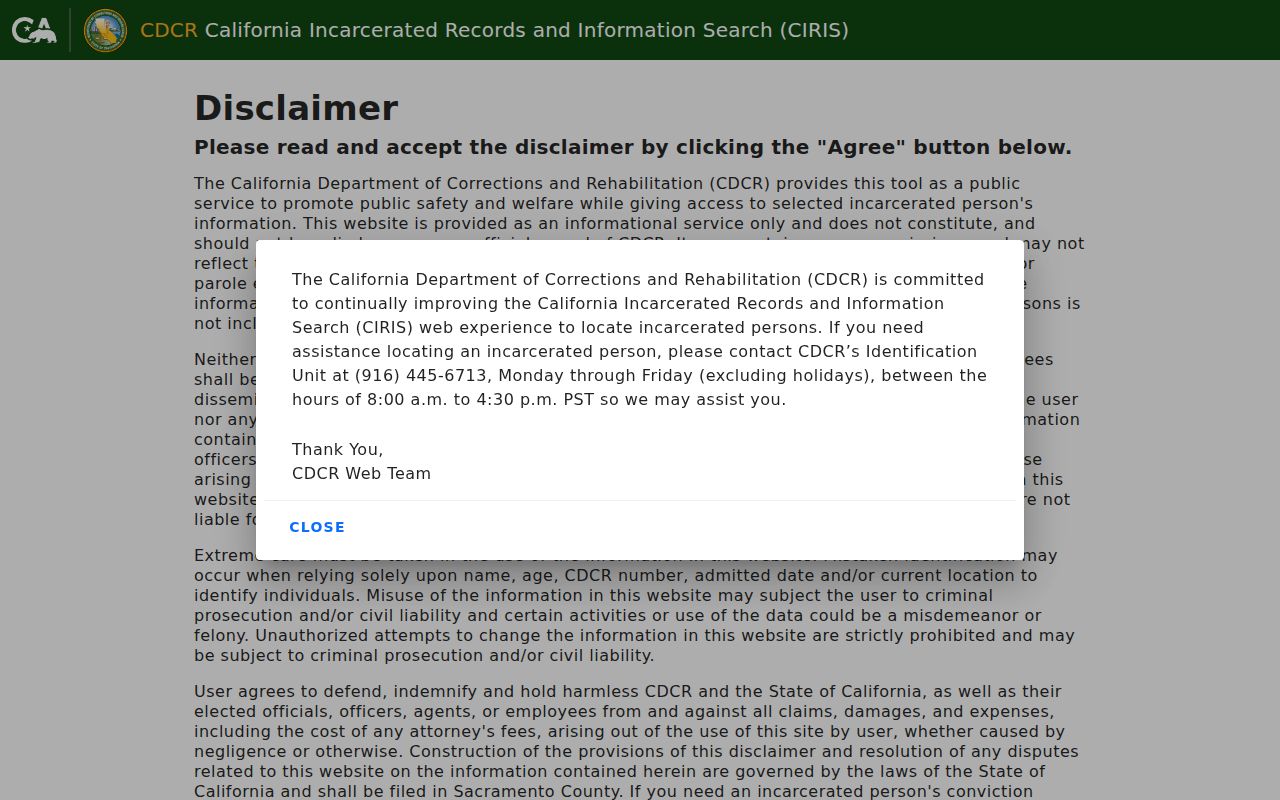
Its fields are about an incarcerated person record, not a current Paramount address or household.
The official California Megan’s Law search provides the protective registry context and its warning about mistaken identity.
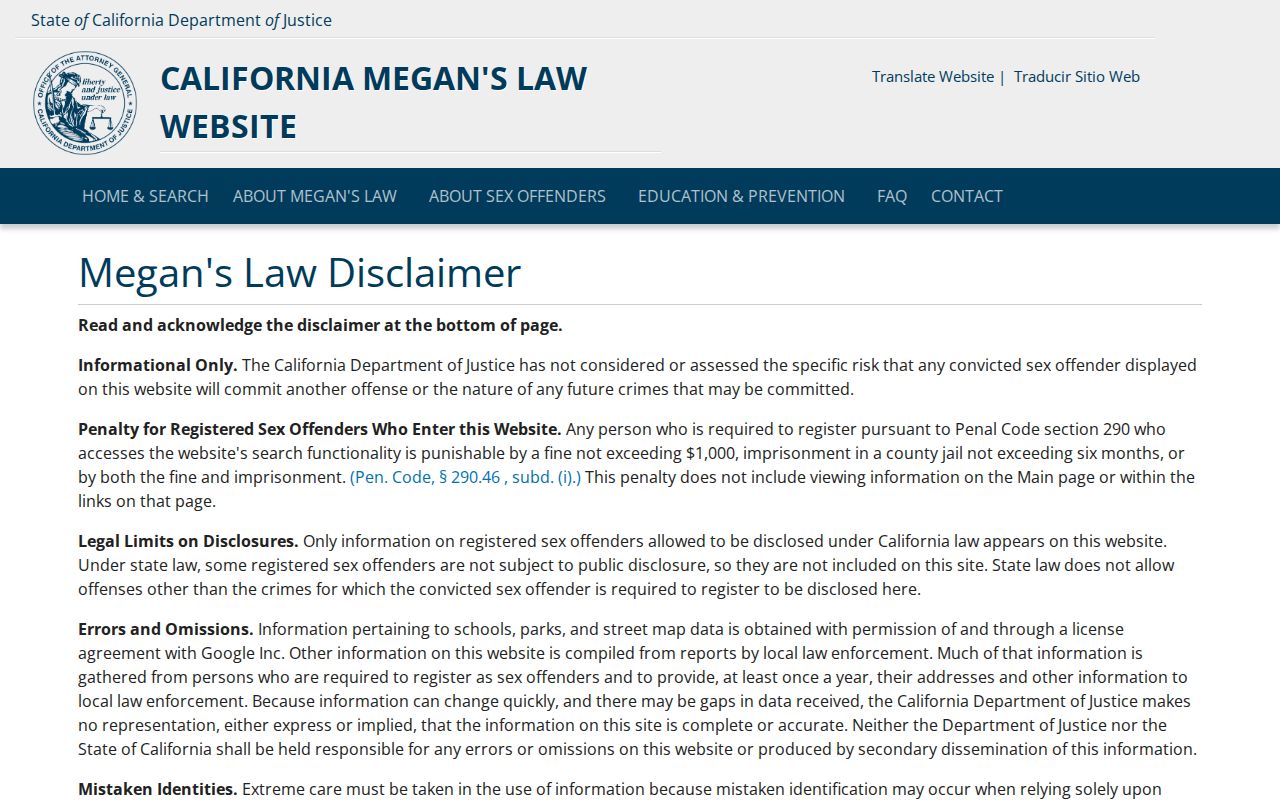
A registry result needs careful identity checks and must never be used to threaten, expose, or harass anyone.
Privacy for a Paramount Resident Lookup
California privacy rights and records access rules work together. The CCPA and CPRA, including Civil Code sections 1798.100 and following, give covered-business customers rights to know, access, delete subject to exceptions, correct, opt out of sale or sharing, limit certain sensitive-information uses, and avoid discrimination. Global Privacy Control can communicate an opt-out. Those rights do not erase an official deed, court record, statutory voter file, or vital record held by its lawful custodian.
The state’s DROP system is the timely change for commercial data brokers. California residents can create an encrypted profile and send one deletion request to more than 500 registered brokers. Processing began August 1, 2026, and the request is to be repeated at least every 45 days. Keep confirmation numbers, submit correction requests for spelling variants, and use the company’s privacy channel when a commercial profile is wrong.
Safe at Home gives eligible survivors of domestic violence, stalking, sexual assault, child abduction, elder or dependent-adult abuse, trafficking, and specified threats a substitute address with mail forwarding. Government Code section 6208.1 restricts harmful public display after a statutory demand, while Government Code section 7922.200 requires local-agency Social Security number redaction. Records can be unavailable because a person is protected, not because a search was done incorrectly.
Lawful use. A Paramount resident lookup is for personal, lawful research, family history, and safe reconnection. Repeated surveillance, threats, doxxing, or unwanted contact can implicate California Penal Code sections 646.9 and 653.2. Stop when a record points to a living person’s protected information.