
Paramount City Directory Shelf Map
Paramount has a verified local directory spine, but no public catalog page lists a complete run or an exact call number. The safest starting point is the local history finding aid, followed by a request to library staff. Exact titles matter because a Paramount directory can sit under a combined place name, a county shelf, or a broader Southern California collection. The table separates confirmed coverage from items that still need a staff check.
| Collection | Years | Where Held | Access |
|---|---|---|---|
| Paramount, Hollydale and Compton City Directory, 1956 | 1956 | Title verified in the city historic finding aid; shelf to confirm | Ask library staff for catalog and retrieval details |
| Paramount Blue Book, Criss Cross City Directory, 1960 Paramount Blue Book, Criss Cross City Directory, 1964 | 1960, 1964 | Titles verified in the city historic finding aid; shelf to confirm | In-person or staff-assisted lookup; no official scanned sample located |
| LA County Library Californiana directories | Dating from the 19th century | Norwalk Library closed stacks | Staff retrieval by phone or email |
| California census schedules | 1850-1910 | Norwalk Californiana Collection | Closed-stack research context; ask staff |
| Federal census | Through 1950 public | NARA, library databases, and genealogy services | Search Paramount, Clearwater, and Hynes place names |
The 1956 title is an alphabetic volume from TLM Publishing Co. in Norwalk. Luskey Brothers & Co. of Anaheim published the 1960 and 1964 Blue Books as criss-cross directories. The titles and years are verified. Complete Paramount shelf coverage, missing years, and call numbers are not published online, so a request should ask staff to check each place name rather than assume one city-only sequence.
Paramount City Directory: 1956 TLM
The verified 1956 TLM volume is the clearest named alphabetic source in the local record trail. TLM Publishing Co. issued it from Norwalk. Its value is the name-first path: a surname can lead to a street address, a spouse notation, a business line, or a second household clue. The combined title also preserves a warning about boundaries. A person tied to Paramount may appear beside Hollydale or Compton entries, and a historical search should not discard a result merely because the title is wider than the present city.
Use the 1956 volume as a fixed point, not as proof that a household stayed at one address. Transcribe the name exactly, including a middle initial, suffix, compound surname, or spelling mark. Record the street and number, then note any nearby entries that share a surname. A directory is a publisher's snapshot. It may omit a household, list one adult, or place a business at a work address. The entry gains strength when the same address appears in a census, permit, deed, newspaper notice, or family paper.
Paramount Directory Books from 1960 and 1964
The two Paramount Blue Book editions from 1960 and 1964 are the local reverse-search bridge. Luskey Brothers & Co. of Anaheim is the verified publisher. Instead of starting only with a surname, a researcher can work from a street and house number when the volume's arrangement supports it. That change is useful for a house-history question, a move between two addresses, or a check on whether a family name continued at the same place.
Read both years as separate observations. A criss-cross listing can show a listed occupant, but the absence of a name does not prove that nobody lived there. Publication boundaries, nonresponse, a renamed street, and a different adult in the household can all break a simple year-to-year match. For present address-keyed parcel work, the Paramount Street Directory uses a different record chain. The historical volumes belong beside that chain, not in place of it.
Paramount Directory Shelves at Norwalk
Deep shelf work begins with LA County Library. Norwalk's Californiana Collection is in closed stacks at 12350 Imperial Highway, Norwalk, California 90650. The reference desk lists (562) 868-4003 and referenceservices@library.lacounty.gov. The collection holds more than 24,000 books and more than 200 magazine and newspaper titles. Its coverage includes California census schedules from 1850-1910, the Los Angeles Star from 1851-1879, nineteenth-century volumes, and official city and county histories.
The local branch supplies a second path. Paramount Library began as the Clearwater Branch in September 1913 with 121 books. It moved in 1930, occupied 15718 Paramount Boulevard in 1946, took the Paramount name in 1948, opened at 7913 E. Madison in 1955, and reached its current building in 1967. Those moves help explain why a branch file, vertical file, or local-history note may be stored under an older branch name. The Paramount Library history and services page is the right place to confirm current branch help before requesting a deep search.
A library staff request should name Paramount, Clearwater, Hynes, Compton, Long Beach, Bellflower, and Downey. It should also list the target years and the exact directory titles. Closed-stack access means staff retrieval, not casual browsing. Ask whether a volume can be viewed, photographed under local rules, or checked through a catalog record.
The following Norwalk Californiana collection description explains the broader shelf context. It confirms useful neighboring collections, but it does not publish a complete Paramount run. That distinction keeps a directory search honest.
Paramount Library's local-history role is shown in the manifest capture from the branch source. It is a branch resource and a route to staff help, not a claim that every historical directory is on its open shelves.
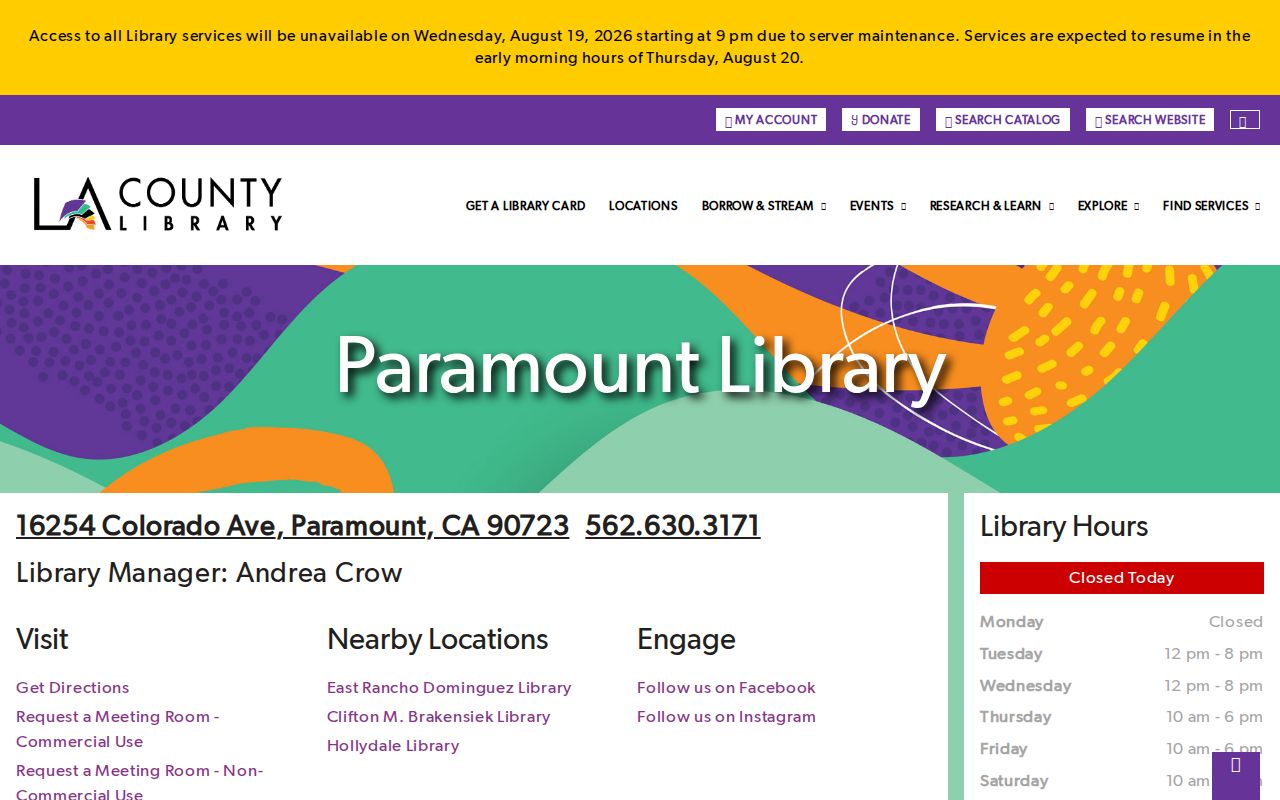
The branch history gives a useful place-based anchor, while Norwalk remains the deeper closed-stack destination for Californiana materials.
Reading a Paramount City Directory Entry
A typical twentieth-century entry is a compact set of clues. The exact local page is not available in an official open scan, so the fields below describe directory conventions, not a promise that every Paramount edition uses every mark. Read the page legend first. Then copy the entry before interpreting it.
| Name | Surname and given name, with a middle initial or suffix when printed. |
|---|---|
| Household note | Spouse in parentheses, widow notation, or another short family clue. |
| Occupation | A historical work or business label, sometimes paired with a business address. |
| Home address | House number and street, with the volume's own abbreviations. |
| Residence marks | Terms such as “h” or “r” may distinguish a householder or resident entry. |
| Owner mark | Some editions use an ownership symbol; verify it in that volume's key. |
Business entries can use a work address rather than a home address. A reverse section may place a telephone number after a street listing, but that feature is a convention, not a verified field for every local issue. Do not turn an occupation line into an identity match by itself. The address, year, household marks, and a second source carry more weight together.
- Criss-cross directory
- A reverse directory arranged by street and house number, often used to work from an address toward a listed name.
- Householder index
- A name-first arrangement that points to the home or household listing associated with a person.
- Abbreviation key
- The publisher's guide to short marks such as residence, widow, or business terms; photograph or transcribe it first.
- Index versus page image
- An index points to a record. The page itself supplies the context needed to check what the index means.
Paramount Reverse Directory Pages
Criss-cross reading is most useful when the question begins with a place. Start with the street as printed in the target year, find the number, and copy every name around the entry. Adjacent numbers can reveal a tract pattern or a family cluster, but they do not establish a relationship. Check the alphabetic section for each name, then compare the result with a census or a deed.
Street labels require care in Paramount. Paramount Boulevard was Ocean Avenue until 1931. Center Street and later Olive became Alondra Boulevard. Clearwater and Hynes remained important search names before the 1948 change to Paramount. A reverse page that appears to miss a modern street may be using the older label. Lot, tract, and legal-description clues can bridge the mismatch when the street name does not.
Use a narrow transcription sheet with columns for year, printed street, number, name, household mark, source page, and next check. That simple record protects against reading the same clue twice and makes a missing year visible. It also separates what the volume printed from what a later source suggests.
Paramount's Clearwater and Hynes Directories
The strongest local story in a Paramount directory search is a change of place name. Clearwater and Hynes were separate communities until they combined under Paramount in 1948. Incorporation followed on January 30, 1957. A directory, census schedule, map, newspaper, or deed made before 1948 may therefore describe the same ground without using the word Paramount.
Clearwater was the more residential early community, while Hynes was more agricultural and dispersed. The area was known as the Milk Shed of Los Angeles and the World's Largest Hay Market, with a reported peak of 25,000 cows and the Hay Tree price-setting landmark. Those details matter because an early household may be tied to a ranch, tract, or rural road rather than a modern street number. The city’s Historic Context Statement connects the local story to permits, maps, photographs, oral interviews, and archives.
- 1931: search Ocean Avenue when a later record points to Paramount Boulevard.
- 1948: search Clearwater and Hynes along with Paramount-area county coverage.
- After the street rename: use Paramount Boulevard and Alondra, while keeping the old labels in notes.
- January 30, 1957: municipal minutes and ordinances begin with Paramount's incorporation.
Trace a Paramount Directory Household
A family-history search works best as a short sequence of dated observations. Do not leap from a 1956 entry to a conclusion about a later household. Pair the printed directory with the public census years and mark each gap. The federal census is publicly available through 1950 under the 72-year rule; 1960 is scheduled for release in 2032.
- Find the first name or address in the 1956 TLM volume, then transcribe the full entry and its page details.
- Check the 1960 and 1964 Luskey criss-cross volumes for the same street and number, then repeat the name-first search.
- Search the 1930, 1940, and 1950 census records under Paramount, Clearwater, and Hynes, using the local boundary of that year.
- Compare spouse, age, occupation label, address, and nearby names, while preserving alternate spellings and older street names.
- Close a gap with a deed, permit, obituary, probate file, newspaper notice, or cemetery record instead of guessing from absence.
A name that disappears may reflect a move, death, nonresponse, a publication boundary, a renamed street, or a different adult listed for the household. An obituary or probate file can supply a lead, but it still needs corroboration. Keep the source year beside every statement so a later researcher can tell whether it came from a directory, a census, or a family paper.
Paramount Directory Research in Archives
Printed directories become more useful when paired with records that explain a person's setting. Paramount Historical Society preserves photographs and local stories. Its published contact is (714) 553-6747 and paramounthistoricalsociety@gmail.com. No current reading-room schedule was located, so an appointment or research request should be arranged before expecting access. The society's holdings are a lead source, not a substitute for the county or library record.
CSUDH South Bay and Gerth Archives provide regional photographs, letters, maps, and related collections involving Paramount, Compton, Lynwood, and Long Beach. The city's historic project also cites the Paramount Library Local History Collection, the Long Beach Telegram and Press-Telegram, Lynwood papers, Hollydale Press, La Opinión, and the Los Angeles Times. A newspaper notice can explain a move or death date that a directory only hints at. A photograph can place a storefront or tract in time.
The California State Archives research-services page is another archive route for statewide material. The Library of Congress city and telephone directory collection is a broader digitized reference, but it does not establish an open Paramount scan. For map context, the Library of Congress Sanborn collection can be searched by Clearwater, Hynes, Compton, or Long Beach, but no Paramount-specific sheet and year were verified in the local sweep. A negative catalog result is useful when recorded as a research limit.
The archives capture below reflects a state-level finding aid, not a scanned Paramount local volume. It belongs in the source chain when a local question reaches beyond the branch shelf.
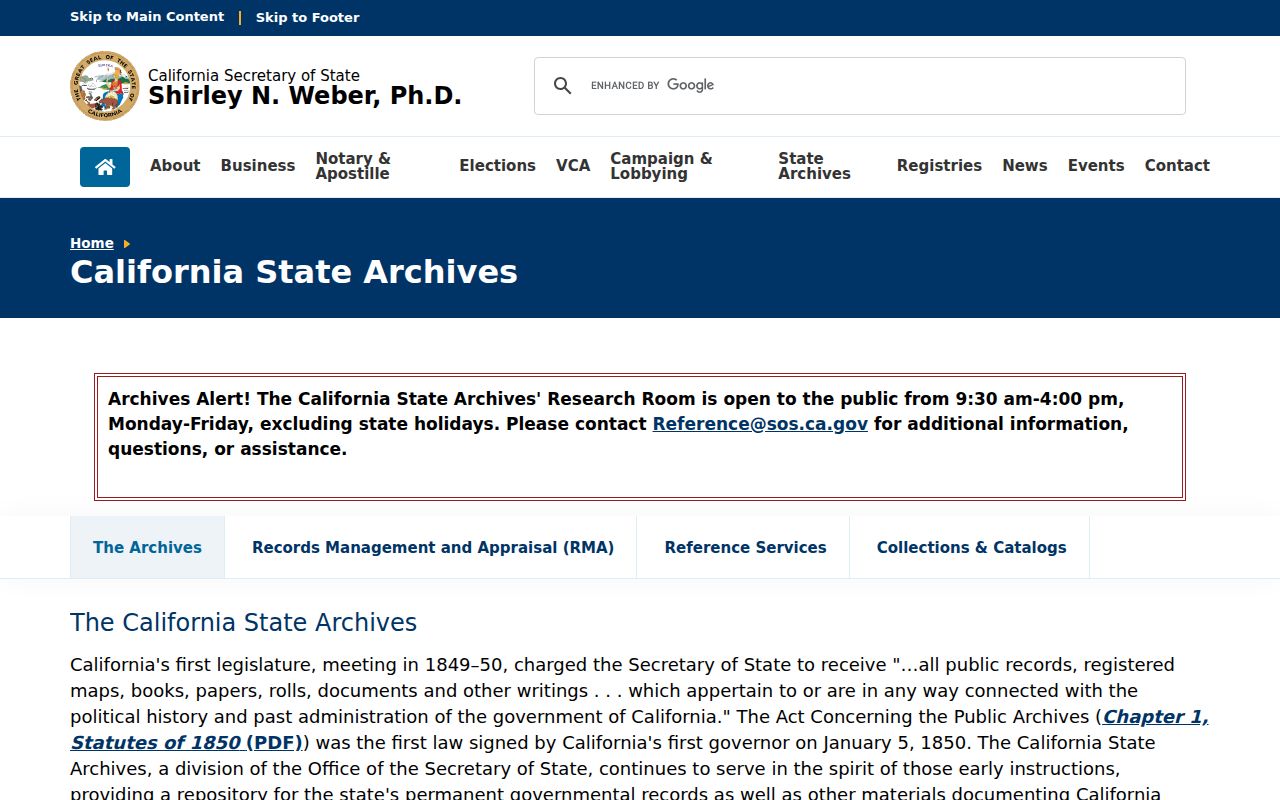
Archive guidance helps identify the right repository, while the exact local volume still requires a catalog or staff confirmation.
Paramount's 2025-26 Directory Finding Aid
Paramount's first Historic Context Statement appeared in 2025 and expanded in 2026 through 1999, with resident and business interviews added to the record map. Its source list joins city surveys, assessments, permits, historic property maps, photographs, newspapers, the Historical Society, the library, and CSUDH. That makes the statement more than a history essay. It is a current finding aid for locating the evidence behind a local name or address.
The Paramount Historic Context Statement also documents the exact 1956 TLM title and the 1960 and 1964 Luskey titles. Shelf and call-number verification remains with the holding institution. When a staff reply identifies a volume, save the title, publisher, year, and repository together. That citation is the difference between a reproducible directory search and a vague reference to an old book.
For one named person, a directory clue can be carried into the Paramount Resident Lookup workflow for modern corroboration. The historical volume remains the source for what it printed in its own year.
The historic-context capture below shows the local project's archive map and verified directory references. It is a timely bridge between older shelf research and present finding aids.
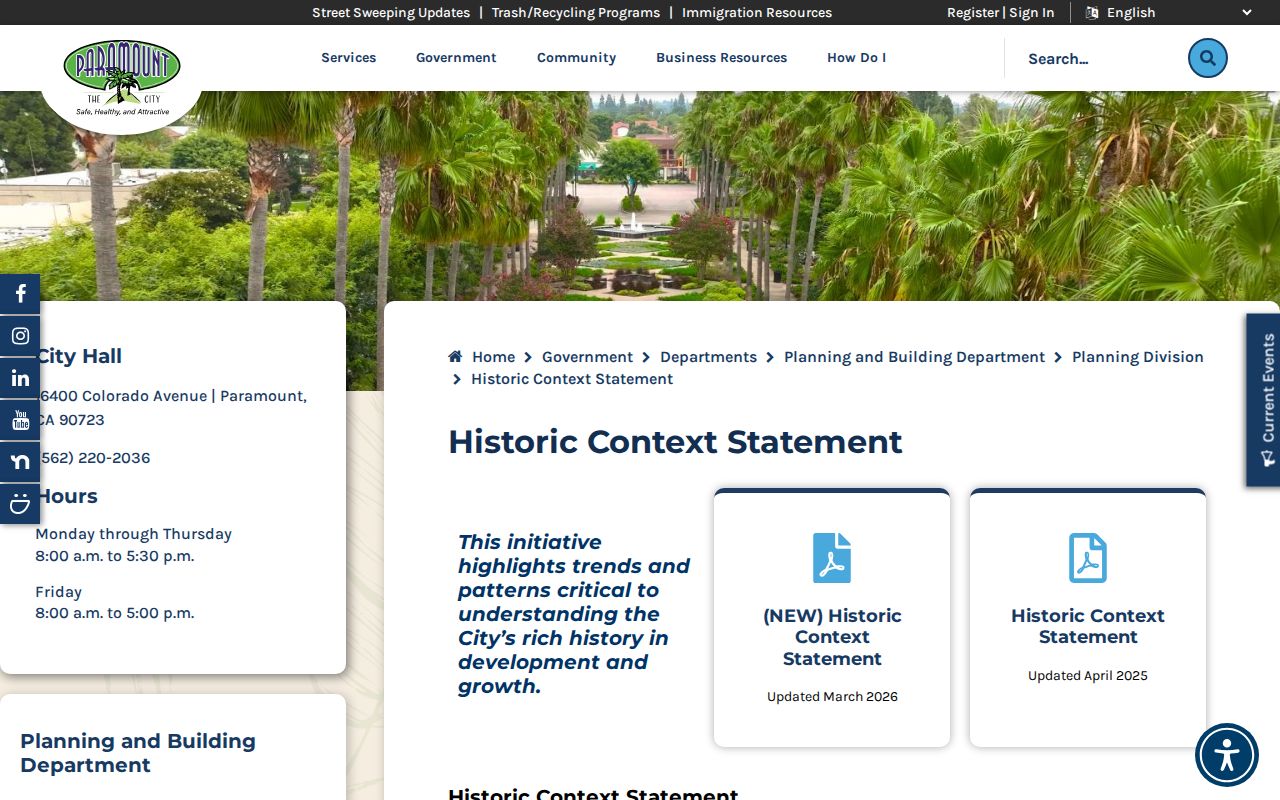
The updated statement helps narrow the next repository request without turning an unverified shelf claim into a fact.